Elina
The Tale of the Vampire BrideElina is one of Vlad Dracula’s three Brides and one of the principal forces shaping Glynis Wright’s transformation. A former peasant’s daughter elevated into the wife and Princess of the “greatest Wallachian warrior of all time,” she treats vampirism not as a curse but as a social and bodily ascent. Her pride in that ascent makes her a compelling counterpoint to Glynis: where Glynis experiences the castle as enslavement, Elina remembers mortal poverty as the true prison. Yet her apparent freedom remains conditional, because the splendor, power, and status she celebrates all exist within Vlad Dracula’s authority.
Identity and Introduction
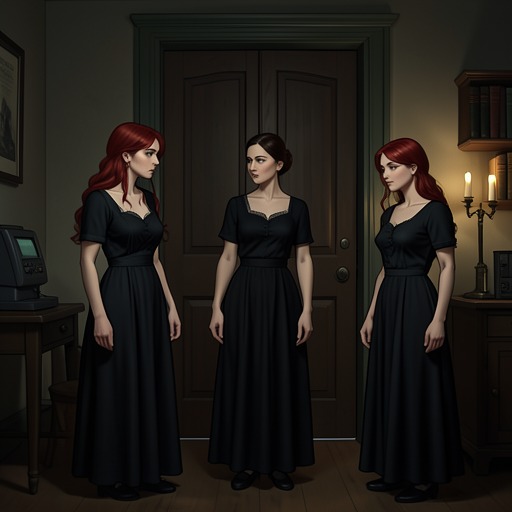
Elina appears alongside Ariana and Cneajna as one of the established Brides of Vlad Dracula. The three women function as a tightly coordinated household group, but Elina is distinguished by her darkly aggressive manner. When Glynis is being carried toward the bedchamber during her forced transformation, Elina follows with Ariana and watches Glynis’s exposed neck with unmistakable longing. Her interest is not merely passive observation: she is physically involved in the danger surrounding Glynis, seizing Glynis’s other arm when resistance develops and later insisting that the older Brides’ precedence gives them authority over the newcomer.
Her speech makes that hierarchy explicit. Elina tells Glynis that the established Brides came first and that Glynis must do as they say. She also mocks Glynis for still thinking of herself as mortal. To Elina, Glynis’s hesitation is evidence of weakness rather than proof of a retained moral self. Elina therefore enters the narrative as both threshold guardian and hostile instructor: she represents the rules of the supernatural household and punishes any attempt to approach vampirism from a mortal perspective.
Mortal Past and Vampire Status
Elina’s strongest statement of identity comes when she defends the life Dracula has given her. She rejects the suggestion that the Brides’ costumes and titles are humiliating, explaining that Vlad dresses them as his Brides and has made them Princesses. Before her transformation, she says, she was only a peasant’s daughter who endured endless toil, meager profit, hunger, and filth. Her memory of deprivation is concrete and emotionally charged; aristocratic clothing, jewels, and the title of wife are not superficial decorations to her, but visible proof that she has escaped the class position into which she was born.
She also remembers the moment of becoming a vampire as exhilarating. Elina recalls loving the transformation of her body and the power that rose within it, then contrasts that experience with Glynis’s reluctance. Her accusation that Glynis is weak turns vampirism into a test of will: those who accept the new body and its power deserve the privileges of the Brides, while those who cling to mortality appear contemptible. This conviction explains why Elina responds to Glynis with animosity rather than sympathy. Glynis’s resistance threatens the value Elina has placed on her own transformation.
Elina’s status is nevertheless inseparable from display and regulation. Glynis resents being forced out of her own clothes and into the stylized garments required by Dracula’s household, while Elina accepts the visual language of Brides and Princesses because it confirms her elevation. Later, Dracula’s control over dress and concealment becomes visible in Buda, where he orders Glynis to wear veils around Andrew Wright and arranges elaborate clothing for the opera. Elina’s earlier celebration of jewels and bridal presentation thus belongs to a wider politics of clothing: female bodies are made legible as wives, princesses, and supernatural possessions through what they are commanded to wear.
Conduct Toward Glynis and the Other Brides
Elina treats Glynis as an intruder who must be disciplined into the collective. She calls Glynis a weakling and says she cannot understand why Dracula wanted her. Her attractive face becomes, in Glynis’s perception, a mask of loathing, joining beauty to overt hostility. Elina’s anger is not occasional. She scoffs when Glynis still identifies as mortal, emerges from a doorway in a dark and threatening manner, and repeatedly frames Glynis’s independence as an affront to the existing order.
The hostility becomes especially dangerous during the first encounters with the Brides. Ariana kisses Glynis while Elina watches Glynis’s exposed neck with desire, and Elina later intervenes physically when the scene turns violent. During the assault on the men at the village, Ariana passes one victim into her embrace, Elina growls and bites the throat of another man who is pawing at Glynis, and Cneajna enthralls a third with her gaze. Elina’s violence is therefore both predatory and protective: she attacks a mortal who threatens Glynis, but she does so through the same appetite and bodily domination that make the Brides terrifying.
The relationship among the Brides is not simply a rivalry for Dracula’s attention. When Cneajna speaks to Glynis about the limitations imposed by the new sister, she explains that Dracula has not granted the older Brides the freedom needed to visit Erzsébet Dolingen. Ariana and Elina must instead deliver their Master’s message to the servant in the village. The established Brides’ movements, feeding, and obligations are controlled by Vlad, and the arrival of Glynis tightens that control. Elina’s resentment toward Glynis consequently has a structural cause: the newcomer is not only a rival but also the reason the older women are denied freedoms they previously possessed.
Powers, Feeding, and Collective Dependence
Elina possesses the physical abilities associated with the Brides. Glynis watches her stretch, fall forward, and mold her body into that of a wolf, a transformation that reveals a power Glynis had not realized could be reached. Elina’s wolf form places her beside Vlad Dracula, who has demonstrated the same capacity, and marks her as more than a decorative wife. She is a mobile, dangerous supernatural being capable of changing shape, while her return to human form beneath the moonlight presents the Brides as creatures at once beautiful, ecstatic, and profoundly inhuman.
Her power does not make her independent. Elina and Ariana help sustain Erzsébet by giving blood, alternating with one another in the feeding ritual while kissing Erzsébet’s forehead and lips. When the effort to move Erzsébet fails, Elina states that all of them have tried together. The statement reveals the practical solidarity of the Brides: despite their rivalry and their obedience to Vlad, they share responsibilities, blood, and labor. Their collective action also exposes their limitations. They cannot simply undo Vlad’s punishment, and their ability to nourish Erzsébet does not amount to the power to free her.
The same interdependence returns in the blood ceremony that completes Glynis’s transformation. The vampires gather around Glynis while Vlad repeatedly tips the goblet, and the Brides support the ritual with their presence and dancing. Vlad then lowers Glynis into blood as it flows around her in dark waves. Elina’s role in this larger system is not that of an isolated predator; she belongs to a ceremonial and familial structure in which blood functions as nourishment, initiation, marriage symbolism, and power. The Brides’ intimacy with one another therefore both resists and reproduces Dracula’s order: they form a female collective, but one organized around the Master’s blood and command.
Hunger, Decay, and Revolt
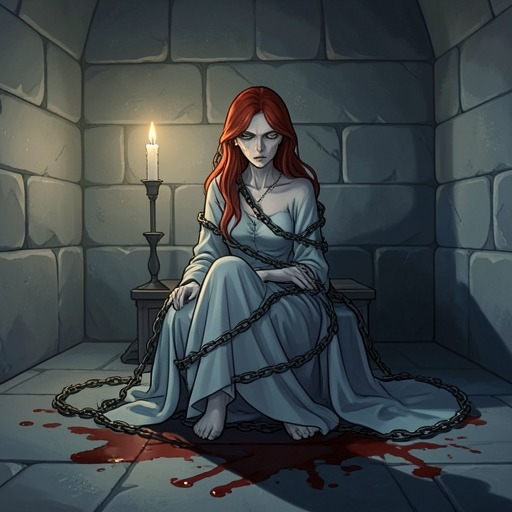
Elina’s later condition reveals the cost of the status she once defended. After prolonged deprivation, she appears with Ariana and Cneajna as a skeletal, frail, gray, and aged figure hiding from flames. The image reverses the earlier presentation of the Brides as jeweled Princesses. Their bodies, once celebrated as transformed and empowered, have become shriveled and nearly corpse-like, while their hunger is made visible as physical decay. Elina’s transformation has not erased the class violence she escaped; it has placed her inside another system in which the Master controls access to blood and can reduce his wives to starvation.
When the final confrontation with Vlad begins, Elina and Ariana drop from the ceiling onto his back and unleash a furious assault that drives him to his knees. Vlad deflects Elina with one arm and throws her into a column with a force that produces a sickening crack, but she returns to the attack with Ariana, leaping from above and tearing at him with nails and teeth. Their resistance is collective, physical, and desperate. It is also unsuccessful against Vlad’s superior strength: while they attack him, he continues crushing Cneajna, whose blood splashes over Vlad, the women, and Glynis.
Elina and Ariana’s revolt changes the meaning of their earlier obedience. The women who once enforced the Bride hierarchy and defended Dracula’s power are capable of turning that same supernatural strength against him when their condition becomes intolerable. Their assault does not deliver victory, but it creates the opening through which the old order can be challenged. At the conclusion of the struggle, Elina and Ariana gaze at Glynis with awe and terror, recognizing that the former newcomer now possesses a power capable of surpassing the household’s established hierarchy.
Narrative Role and Significance
Elina is the clearest embodiment of vampirism as both emancipation and captivity. Her mortal history gives her a reason to value Dracula’s dark gift: it has replaced hunger, filth, and exhausting labor with jewels, rank, bodily power, and the title of Princess. Her contempt for Glynis is therefore ideological as well as personal. Glynis sees the Bride identity as another restrictive society, while Elina sees it as the first social position that has allowed her to feel elevated and powerful.
That contrast makes Elina essential to the novel’s treatment of gender, class, and the politics of appearance. The title of wife does not abolish subordination, and the splendor of the Bride’s costume does not prove freedom. Elina’s pride shows how domination can be experienced as privilege when it rescues someone from an earlier deprivation. Her eventual starvation and attack on Vlad expose the instability of that bargain: the Bride is granted beauty, status, and supernatural strength only so long as the Master permits her to possess them.
Elina also gives the Brides’ collective a shifting emotional range. She is an enemy to Glynis, a fellow feeder and conspirator to Ariana and Cneajna, a participant in ritual, and finally a rebel against Vlad. Her arc does not culminate in a separate escape or a clearly narrated redemption. Instead, it ends in recognition: faced with Glynis’s transformed power, Elina understands that the new sister has become a force beyond the old arrangement. That look of awe and terror is the final measure of Elina’s position—still formidable, still resistant, but no longer secure within the world she once celebrated.